

B2B marketing consulting services deliver strategic expertise that transforms how your organization attracts, engages, and converts business buyers. These services range from comprehensive go-to-market strategy and demand generation to account-based marketing programs and sales enablement frameworks. For sales leaders and professionals, the right consulting engagement means better qualified leads, shorter sales cycles, and revenue targets you can actually hit.
The marketing consulting industry reached USD 36.65 billion in 2026 and continues expanding as B2B companies recognize that traditional tactics no longer cut through the noise. Your buyers research solutions independently, engage across multiple channels, and expect personalized experiences long before they talk to your sales team. That gap between what buyers expect and what most marketing teams deliver is exactly where consultants add value.
Working with a B2B marketing consultant isn’t about outsourcing your strategy. It’s about bringing in specialized knowledge your internal team may lack: conversion rate optimization, marketing automation architecture, content strategies that actually generate pipeline, or industry-specific positioning that resonates with decision-makers. The firms delivering these services range from global players like Accenture and Deloitte to boutique agencies focused exclusively on B2B sectors like technology, professional services, or manufacturing.
This guide explains what B2B marketing consulting services actually include, when the investment makes sense for your business, and how to collaborate effectively with consultants to drive measurable sales results. You’ll learn to evaluate providers, set clear success metrics, and ensure consulting work translates into revenue growth rather than expensive reports that gather dust.
What B2B Marketing Consulting Actually Delivers for Sales Teams
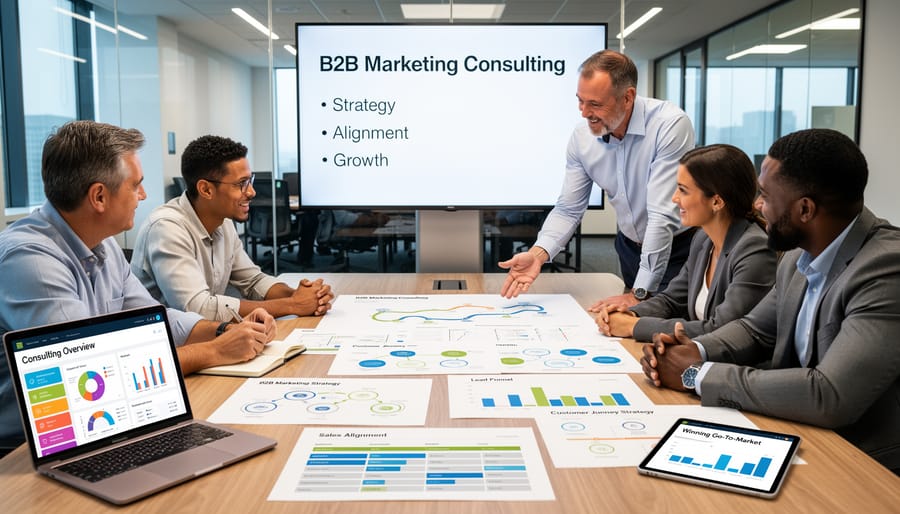
B2B marketing consulting translates marketing expertise into sales-ready assets your team can actually use. Unlike generic marketing advice that focuses on awareness and engagement metrics, specialized B2B consulting delivers frameworks, positioning, and messaging designed to shorten sales cycles and improve close rates.
The core service types break down into distinct categories, each with direct implications for how your sales team operates:
- Strategy and Planning
- Development of go-to-market frameworks, competitive positioning, and account-based marketing blueprints that align with your sales methodology and territory structure.
- Branding and Advertising
- Creation of brand narratives, value propositions, and campaign assets that give sales professionals consistent messaging tools and credibility in prospect conversations.
- Customer Intelligence and Segmentation
- Analysis of buying behaviors, decision-maker profiles, and market research that helps sales teams prioritize accounts and tailor their approach by segment.
- Content and Enablement Development
- Production of case studies, white papers, ROI calculators, and presentation decks that support specific stages of your sales process rather than general thought leadership.
What separates B2B consulting from general marketing services is the focus on decision-making complexity and longer buying cycles. B2B consultants build frameworks around multiple stakeholders, committee decisions, and technical evaluation processes. They understand that marketing’s job isn’t to generate clicks but to create the conditions where sales conversations can happen at higher levels with better-prepared buyers.
The practical difference shows up in deliverables. Generic marketing might hand you a brand refresh and social media calendar. B2B marketing consulting gives you a stakeholder mapping template, objection-handling scripts tied to specific buyer personas, and a content library organized by sales stage. One produces visibility; the other produces pipeline velocity.
The Market Reality: Why Investment Is Growing
The numbers tell a story sales professionals can’t afford to ignore. The marketing consulting market stands at approximately USD 36.65 billion in 2026, with projections showing growth to USD 45.52 billion by 2031. That’s a 24 percent increase in five years, signaling a fundamental shift in how businesses approach growth.
This expansion isn’t happening because companies have extra budget to burn. Organizations are investing in marketing consulting because they’ve connected the dots between strategic positioning and revenue outcomes. When your prospects can’t differentiate your solution from three competitors, when your messaging doesn’t land with decision-makers, or when your sales cycle drags because marketing hasn’t warmed the pipeline, those aren’t marketing problems. They’re revenue problems that marketing consulting is increasingly brought in to solve.
Retail and consumer goods companies are leading the charge, followed closely by technology and media firms. These sectors understand that sophisticated buyers conduct extensive research before ever talking to sales. If your marketing strategy doesn’t meet them there, you’re starting every conversation from behind.
For sales professionals, this trend creates leverage. When your organization considers consulting investment, you have an opportunity to shape the engagement around sales outcomes rather than abstract brand exercises. The question isn’t whether companies will spend on marketing expertise, they clearly are. The question is whether sales teams will participate in directing that investment toward initiatives that actually shorten sales cycles, improve lead quality, and strengthen competitive positioning.
The growth figures reflect a market that’s figured out marketing consulting delivers measurable results when done right. Sales leaders who recognize this shift early position themselves to benefit from better-qualified prospects, clearer value propositions, and stronger market positioning that makes closing easier.
How Marketing Consulting Solves Real Sales Challenges

Marketing consulting transforms abstract marketing activities into concrete sales advantages by addressing the friction points that actually slow revenue teams down. When consultants diagnose misaligned messaging, they’re solving the problem where your sales team wastes the first three discovery calls re-explaining what your company does because the website promises something different than what you deliver. That disconnect costs deals.
Consider lead quality, the complaint every sales professional knows intimately. Marketing consulting interventions don’t magically generate better prospects, they redesign qualification frameworks, adjust campaign targeting parameters, and align content offers with buying stage signals. A consulting team might discover your gated content attracts early-stage researchers when your sales cycle requires buyers with budget authority and immediate need. The fix isn’t more leads; it’s different lead criteria tied to what your team can actually close.
B2B marketing consulting specifically addresses these challenges that erode sales effectiveness:
- Messaging that resonates with marketing committees but confuses actual buyers during sales conversations
- Brand positioning that fails to differentiate your offering in competitive situations, forcing sales into price-based negotiations
- Content strategies that generate vanity metrics without supporting business prospecting or pipeline velocity
- Campaign attribution models that hide which marketing activities actually contribute to closed revenue
- Prospect nurture sequences disconnected from your sales methodology and conversation flow
The value emerges when consultants map marketing investments to sales outcomes you can measure, shorter sales cycles, higher win rates in competitive deals, reduced time spent qualifying unfit prospects. They create conditions where your selling skills matter more because the groundwork is solid. A consultant might restructure your demand generation to align with account-based selling motions, ensuring marketing touches the same accounts your sales team is actively pursuing rather than scattering effort across thousands of unlikely buyers.
This isn’t about consultants promising revenue miracles. It’s about removing the structural misalignments that make selling harder than it needs to be.
When Your Organization Actually Needs a Marketing Consultant
Not every sales challenge demands outside help. Marketing consultants add genuine value in specific situations, but they’re not a universal fix. Bringing one in when your team already has the answer wastes budget and creates dependency. The decision requires honest assessment of your capabilities and the problem’s scope.
Market expansion into unfamiliar territory is a legitimate trigger. If you’re entering a new geography, industry vertical, or buyer segment where your team lacks insight, external expertise fills that gap. A consultant who has navigated similar expansions brings frameworks and benchmarks your internal team would take months to develop. The same logic applies to product launches where positioning isn’t obvious. When your sales team struggles to articulate differentiation or the value proposition feels generic, that’s a signal that strategic marketing thinking is missing.
Competitive repositioning often requires a consultant’s perspective. When you’re losing deals to the same competitors repeatedly, or your messaging sounds identical to three rivals, an outside view can break the pattern. Internal teams get too close to their own story. Similarly, if you’re restructuring your sales organization, consolidating territories, shifting from transactional to consultative selling or moving upmarket, marketing strategy needs to shift in parallel. A consultant can align those pieces faster than a stretched internal team juggling daily execution.
Avoid consultants who guarantee specific revenue outcomes or promise transformation in unrealistic timeframes. Ethical consulting acknowledges uncertainty and focuses on building capabilities, not creating dependency. If the consultant resists sharing their methodology or discourages internal involvement, walk away. The goal is strategic clarity and execution support, not outsourcing your thinking entirely.
Working Effectively with Marketing Consultants as a Sales Professional

The best marketing consulting engagements function like well-run sales partnerships: clear expectations, regular communication, and shared accountability. When sales professionals approach consultants as collaborators rather than outsiders, both teams benefit from combined expertise.
Start with honest data sharing. Marketing consultants can’t build effective strategies without understanding your actual pipeline metrics, win rates, buyer objections, and competitive losses. Sanitize client names if needed, but provide real numbers. A consultant working from guesswork wastes everyone’s time and budget. Share CRM data, call recordings, lost deal post-mortems, and the unfiltered feedback your reps hear during discovery calls. This transparency builds trust and produces strategies grounded in reality.
Establish communication protocols early. Designate one primary contact from your sales team, typically a director or senior manager, to coordinate with the consulting team. This person filters questions, gathers input from reps, and ensures consultants aren’t interrupting active selling time. Schedule weekly sync meetings during the engagement, not monthly check-ins that let misalignment fester. Sales cycles move quickly; marketing strategies need to adapt at the same pace.
Create structured feedback loops that capture frontline intelligence. Your sales reps interact with buyers daily and hear exactly which messaging resonates, which value propositions fall flat, and which competitive comparisons prospects raise. Build a simple system, a shared Slack channel, a weekly email digest, a brief Friday debrief, that channels these insights to consultants in real time. Marketing strategies built on assumptions fail; those built on continuous sales feedback succeed.
- Define success metrics together before the engagement begins, not revenue alone, but lead quality scores, message adoption rates, and sales cycle changes you’ll track jointly.
- Schedule a kickoff workshop where consultants shadow sales calls, attend pipeline reviews, and meet reps to understand daily workflows and challenges firsthand.
- Establish monthly alignment sessions where sales leadership and consultants review what’s working, what needs adjustment, and how market feedback should shape strategy.
- Create a shared project tracker that shows marketing deliverables, sales implementation milestones, and dependencies so both teams stay synchronized.
- Designate a few sales reps as early adopters who test new messaging, positioning, or tools before full rollout, providing candid feedback to refine approaches.
Treat consultants as temporary team members, not vendors. Invite them to your sales meetings, include them in Slack channels where deals are discussed, and give them access to the same tools your team uses. The more they understand your culture, constraints, and daily pressures, the more practical their recommendations become.
Challenge consultants when recommendations seem disconnected from sales reality, but do it constructively. If a proposed messaging shift doesn’t match what buyers actually say in calls, speak up with specific examples. Good consultants want this pushback because it improves their work. Weak consultants get defensive. That distinction tells you whether you’ve hired partners or pretenders.
Document everything. As consultants develop strategies, frameworks, and tools, ensure your team captures the thinking behind them, not just the deliverables. When the engagement ends, you want your sales organization to sustain the improvements, not revert to old habits because no one remembers why changes were made. This knowledge transfer separates consulting investments that compound over time from those that fade once the contract expires.
Evaluating Consulting Proposals: What Sales Leaders Should Ask
Start with the proposal’s methodology section. Ask consultants to describe their diagnostic process before they prescribe solutions, any firm that jumps straight to recommendations without understanding your sales cycle, customer journey, or current pain points is selling a template, not strategy. Legitimate consultants from firms like Accenture, Deloitte, McKinsey, BCG, and PwC typically invest substantial discovery time, though boutique firms often provide more customized approaches at lower overhead.
Demand specifics on measurement. How will they track impact on pipeline velocity, conversion rates, or sales cycle length? Proposals that promise brand awareness or engagement metrics without connecting them to revenue indicators miss the point for sales leaders. Request benchmark data from similar engagements in your industry, retail and consumer goods projects differ fundamentally from technology and media implementations.
Evaluate industry experience by asking for client references you can actually contact, not just logo slides. A consultant who has worked with three competitors will understand your market’s buying committees and procurement cycles better than a generalist with impressive credentials but no sector depth. Boutique firms often excel here because they specialize rather than spread expertise thin across every vertical.
Question ROI expectations directly, applying the same sales pitch factors you’d use evaluating any vendor. With the marketing consulting market reaching approximately USD 37 billion in 2026, competition is fierce enough that consultants should confidently discuss payback periods and success metrics. If they deflect with vague promises about long-term value, walk away. Ethical consulting relationships require mutual accountability from the start, not just during renewal conversations.
Building Internal Capabilities While Using External Expertise
The smartest sales organizations treat external consulting engagements as temporary partnerships with permanent learning outcomes. When you bring in marketing consultants, create structured knowledge transfer from day one. Designate team members to shadow consultants during strategy sessions, ask questions about methodology, and document decision frameworks. This isn’t about stealing intellectual property, it’s about understanding how experienced marketers approach problems so your team can think more strategically when consultants move on.
Build capability systematically by identifying specific skills gaps the consultants are filling. If they’re refining your messaging architecture, assign a sales enablement lead to learn that process. If they’re improving lead scoring models, have your ops manager participate actively rather than just receive the finished product. Request working sessions where consultants explain their thinking, not just deliverables. Most reputable firms expect this collaborative approach, they know capability-building clients become long-term partners, not one-time transactions.
Create sustainable marketing-sales alignment by establishing shared metrics and regular touchpoints that outlast the consulting engagement. Document the frameworks consultants introduce, whether it’s buyer journey mapping, message matrices, or content strategies, and assign internal owners to maintain and evolve them. The goal isn’t self-sufficiency in every marketing discipline; it’s developing enough fluency that your sales team can contribute meaningfully to marketing decisions and spot when external help genuinely adds value versus when you’re outsourcing thinking you should own.
Invest in professional development that complements what consultants provide. If they’re building your account-based marketing strategy, send team members to workshops on ABM execution. If they’re repositioning your brand, pursue certifications in strategic messaging. This continuous learning mindset, central to building a resilient sales career, ensures external expertise accelerates internal growth rather than creating dependency.
The rise of B2B marketing consulting is not a challenge to your role as a sales professional, it’s an opportunity to multiply your impact. When you understand how strategic marketing consulting shapes buyer perception, lead quality, and market positioning, you gain leverage that individual effort alone can’t match. The consulting market’s growth to USD 36.65 billion in 2026 reflects what forward-thinking organizations already know: integrated marketing and sales expertise drives results that isolated tactics never will.
Treat marketing consulting as a catalyst for your career advancement. Sales professionals who learn to collaborate with consulting teams, interpret marketing strategy, and translate brand positioning into conversations bring unique value to their organizations. This isn’t about defending territory, it’s about expanding what you can accomplish.
As this landscape evolves toward the projected USD 45.52 billion by 2031, engage with these trends ethically and strategically. Ask tough questions. Demand measurable outcomes. Share what you learn with your peers. The sales community grows stronger when we embrace new disciplines that make our work more effective, not when we resist them. Your willingness to adapt and integrate marketing consulting into your approach will separate you from those who wait for change to force their hand.